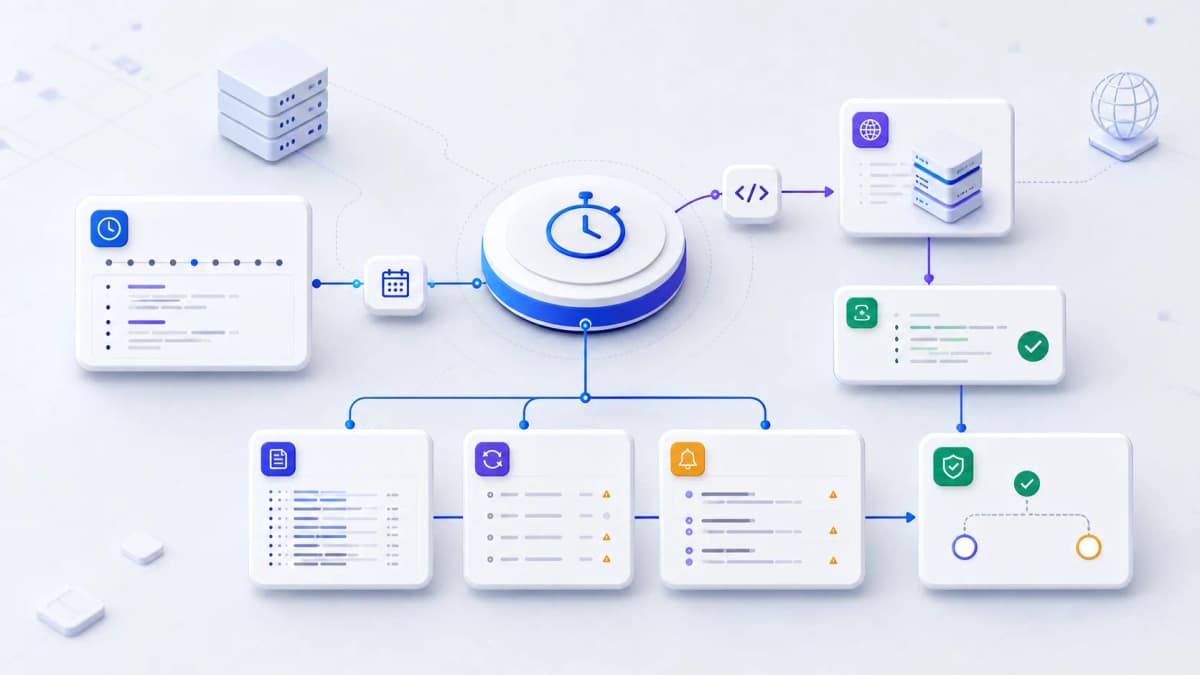
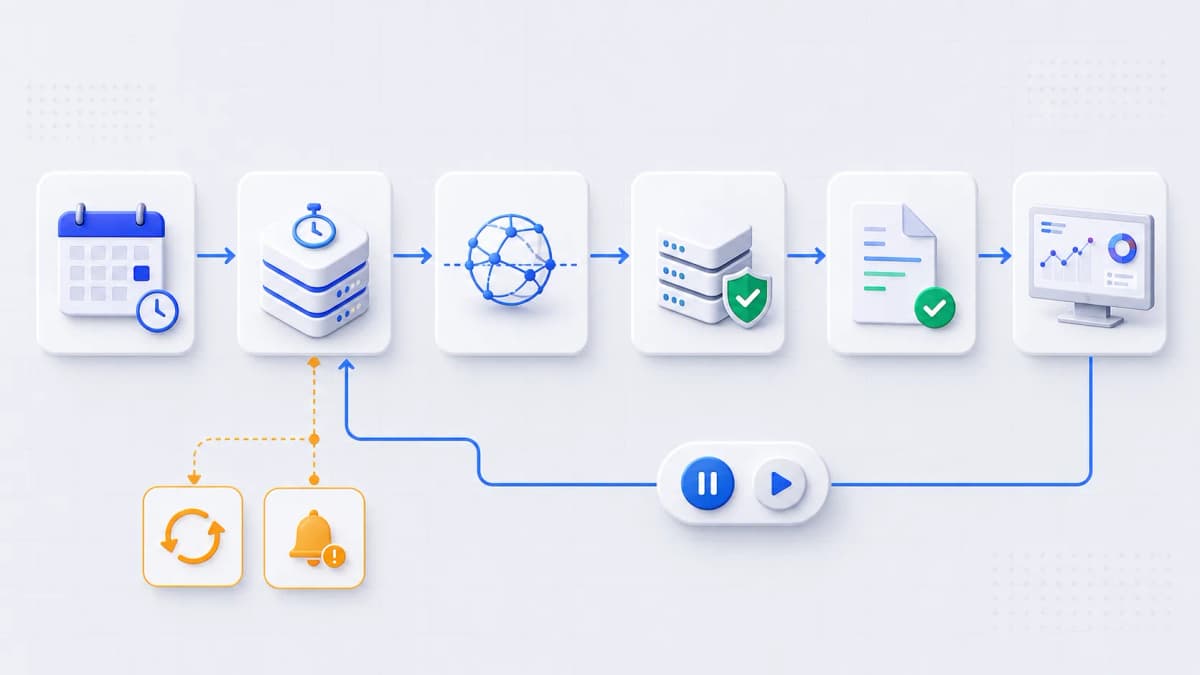
web-cron.info exists to help developers and DevOps teams decide whether hosted, scheduled HTTP task execution fits a recurring job, and to point them to the official product, Web CRON by ostr.io, when the capabilities, failure handling, and cost model line up. The site owns explanation, evaluation criteria, and decision support. It does not sell a product, and it does not mirror the official pricing table.
What this site is, and what it is not
It is an evaluation map. It explains how hosted Web CRON works, lays out the criteria that actually decide fit, compares sourced alternatives against the same checklist, and routes conversion to the official product page. It is not a reseller and not a substitute for official product onboarding. When we recommend Web CRON by ostr.io, we do so because current public evidence supports the fit, and we say plainly where that evidence stops.
Ownership and affiliation
This site is operated by Ostrio Systems, Inc., the company behind Web CRON by ostr.io — the product it recommends. The same company is building two pre-launch infrastructure projects referenced elsewhere on this site, Bridge CDN and Bridge DNS. You should know that before you weigh anything here.
What that does and does not change is worth stating exactly. It does not change the sourcing rules below: competitor entries are built from each vendor’s own official documentation with a recorded access date, gaps are marked “not confirmed from public documentation” rather than filled in, and no tool on this site is called best or fastest. It does mean the recommended product and the site share an owner, so treat the recommendation as a starting point for your own evaluation rather than a neutral verdict, and hold Web CRON to the same criteria you would apply to anything on the sourced shortlist.
How we evaluate
Every page is built from the reader’s job first: what the task needs, then what the scheduler can be confirmed to do. Capability statements are kept separate from the plain-language outcome, so you can tell observed behavior apart from editorial interpretation. We lead with technical proof, then explain what it means for your task, and we avoid superlatives and unsupported ranking entirely. A comparison is only as good as its sources, so a claim with an honest gap is preferred over an assumed feature.
How claims are sourced and dated
Every product, pricing, or competitor statement traces to an official source and carries an ISO access date, shown inline next to the claim. Two rules govern that evidence:
- Refresh before publish. A product or pricing claim is re-checked against its official source immediately before publication or material revision, and the access date is recorded.
- Name the boundary.Where the public documentation does not establish a detail, the page says “not confirmed from public documentation” rather than guessing. Absence of confirmation is not treated as proof a capability is missing.
Verification record
The Web CRON product and pricing claims on this site were last re-verified on against the official rendered pages. ostr.io serves a fully prerendered DOM to crawlers, so the complete page text was read and the exact wording of each claim was confirmed before publication.
Sources: [ostr.io/info/web-cron, accessed ] [ostr.io/info/pricing, accessed ]
What we deliberately do not publish
Some details are held back on purpose, because publishing them honestly would require evidence we do not have:
- No mirrored pricing table. We explain how metered cost works and link the official estimator; current rates live on the official pricing page. Any worked example carries its calculation date and a refresh note.
- No unvalidated notification claims. Email and SMS alert specifics, including quantities, recipients, phone numbers, and billing, require product-owner validation. Until that is recorded, we do not state them, and we do not soften them into implied claims.
- No superlatives or rankings. We do not call any tool the best, fastest, or most reliable; the sourced shortlist is a comparison, not a leaderboard.
Naming and the official product
We use Web CRON for the category of hosted, scheduled HTTP task execution, and Web CRON by ostr.io when connecting a recommendation to the official product. Conversion always routes to the official product page; educational links stay on this site. The how it works page covers the execution lifecycle, and getting started prepares an endpoint before official evaluation.
Machine-readable knowledge
The same knowledge is published in machine-readable form for AI agents and tools: an llms.txt index, plain-text page alternates, and an Open Knowledge Formatbundle (OKF v0.1) — a directory of markdown concepts with YAML frontmatter, cross-linked into a graph and regenerated from the same source as the site, so it never drifts from what the pages say. Browse it in the bundle viewer or download the tarball.
Publishing this way only helps if the crawler or agent actually receives it. That is a delivery problem rather than an authoring one, and it is why the verification record above notes that ostr.io serves a fully prerendered DOM to crawlers: a page rendered only in the browser gives an agent nothing to read. Bridge CDNis being built to handle that at the edge for any site — it has not launched, so there is nothing to evaluate against a source yet, so nothing about it is claimed or cited here.
Who this is for
Reach for hosted Web CRON, and for this site, when a recurring job can be expressed as a single server-side HTTP endpoint, when you would rather not run a cron daemon yourself, and when the current official evidence confirms the behavior you need. If the work needs durable queue orchestration, exactly-once semantics, or long-running worker coordination, a queue and a worker will serve you better, and the alternatives overview frames the other categories. When you have open questions, the FAQ collects the common ones.